
So you've decided to try essential oils. Maybe you picked up a bottle somewhere, or a friend swears by lavender for sleep, or you've been reading about rosemary oil for hair growth and want to see what the fuss is about. Whatever brought you here, welcome.
The good news is that essential oils aren't complicated once you understand a few key principles. The bad news is that there's a lot of noise online - overselling, overclaiming, and confusing information that makes the whole thing seem more complex or more miraculous than it actually is.
This guide gives you the honest essential oils for beginners foundation: what they are, which ones to start with, how to use them safely, and how to build a starter kit that actually earns its shelf space.
Shop Majestic Pure Essential Oils: https://majesticpure.com/collections/100-pure-essential-oils-for-aromatherapy-natural-wellness
What Are Essential Oils and How Do They Work?
essential oil basics first. Essential oils are concentrated aromatic compounds extracted from plants - typically through steam distillation or cold pressing. They capture the plant's scent and many of its active chemical compounds. The word 'essential' refers to the essence of the plant's aroma, not that they're essential for health.
What makes them useful isn't the scent itself but the active compounds within them. Linalool in lavender has genuine calming properties. Terpinen-4-ol in tea tree oil is genuinely antibacterial. Cedrol in cedarwood oil has measurable sedative effects. These aren't claims unsupported by research - there's a growing body of peer-reviewed science documenting what these compounds actually do.
That said, essential oils are tools, not cures. They work best as part of a broader wellness routine, not as standalone treatments for medical conditions.
Essential Oil Basics: What You Need to Know Before Buying
Purity Matters More Than Price
The single biggest mistake beginners make is buying cheap, adulterated oils. A $5 lavender oil and a $25 lavender oil can look identical on the shelf, but perform completely differently. Many budget oils are diluted with carrier oils, cut with synthetic fragrance compounds, or labelled with a plant name but actually contain very little of the actual plant extract.
What to look for on any bottle:
• 100% Pure stated clearly on the label
• Independent lab testing mentioned - this verifies purity and constituent levels
• Botanical name (e.g., Lavandula angustifolia, not just 'lavender')
• Amber glass bottle - plastic degrades over time, and some essential oil compounds react with it
• No 'fragrance oil' or 'perfume oil' language - these are synthetic and not the same thing
Majestic Pure oils are independently tested by a third-party lab for purity and constituents, with no fillers or additives. Every bottle comes with a quality guarantee. That's the baseline standard to look for.
how to use essential oils: The Three Main Methods
There are three main ways to use essential oils, each with different applications:
• Aromatherapy/Diffusion: Add drops to an ultrasonic or heat diffuser. The aroma fills the room. Best for mood support, sleep, stress relief, and respiratory help. No dilution required.
• Topical application: Diluted in a carrier oil and applied to skin. Best for targeted uses - scalp treatments, muscle relief, spot treatments, pulse-point anxiety relief. Always dilute first.
• Inhalation: Directly from the bottle, or a drop on a tissue. Fast-acting for acute situations. No dilution required.
A fourth method - ingestion - is sometimes mentioned but is not recommended for aromatherapy-grade essential oils. These are not food-grade products.
The must-have essential oils: What to Start With
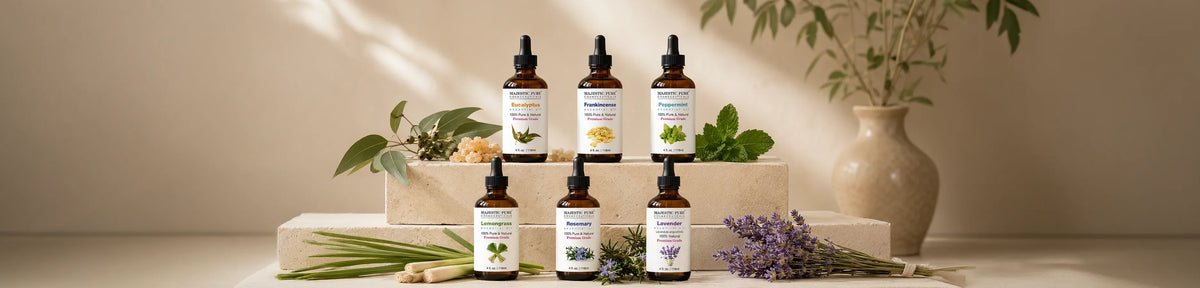
A good essential oil starter kit doesn't need to be 30 bottles. Start with five to seven genuinely versatile oils that cover the most common uses. Here are the best essential oils to start with based on versatility, research backing, and practical everyday utility:
1. Lavender essential oil - The Universal Starting Point
If you only buy one essential oil, make it lavender. It's the most researched, most versatile, and most forgiving for beginners. Sleep support, stress relief, skin soothing, minor burn and insect bite care, mood support - lavender handles all of it. It also blends with almost every other oil, which makes it the foundation of most aromatherapy combinations.
Shop: https://majesticpure.com/products/lavender-essential-oil-4-oz
2. Peppermint oil - Everyday Energy and Relief
Peppermint oil earns its place in any starter kit through sheer usefulness. Headache relief, sinus congestion, scalp stimulation, muscle soreness, mental focus - few oils match its practical range. It's also fast-acting, which beginners appreciate. Add 3 drops to a diffuser when you need to focus, or dilute and massage into your temples for tension relief.
Shop: https://majesticpure.com/products/peppermint-oil
3. Tea Tree Oil - Natural Skin and Surface Care
Tea tree oil's antibacterial, antifungal, and anti-inflammatory properties make it one of the most practically useful oils to have. Acne spot treatment, natural cleaning sprays, scalp health, nail care - it pulls weight in both beauty and home care routines. Because it's potent, always dilute for skin use.
Shop: https://majesticpure.com/products/tea-tree-essential-oil-4-fl-oz
4. Rosemary essential oil - Hair and Focus
Rosemary essential oil has become one of the most searched oils online, largely because of its well-supported use for hair growth. It's also genuinely useful for focus and mental clarity when diffused. It's a good oil for people who want practical, evidence-backed uses.
Shop: https://majesticpure.com/products/rosemary-essential-oil-100-pure-and-natural-4-fl-oz
5. Eucalyptus Oil - Breathing and Muscle Relief
Eucalyptus oil is the go-to for respiratory support. Cold and congestion, sinus pressure, chest tightness - it's reliably effective via steam inhalation or diffusion. Also useful for muscle soreness in a diluted massage blend. Good to have in your kit before cold and flu season arrives.
Shop: https://majesticpure.com/products/eucalyptus-oil-4-oz?_pos=3&_psq=euca&_ss=e&_v=1.0
6. Frankincense oil - Skin and Calm
Frankincense oil is the slow-burning favourite of the essential oils world. Its anti-ageing skin benefits, anti-anxiety properties, and warm, grounding aroma make it one of the most loved oils among people who've been using essential oils for a while. It's slightly more expensive than the others on this list, but a small amount goes a long way.
Shop: https://majesticpure.com/products/frankincense-essential-oil-4-oz
7. Bergamot essential oil - Mood and Daytime Calm
Bergamot essential oil rounds out a well-balanced starter kit. It addresses anxiety without sedating, lifts mood without stimulating, and blends beautifully with both lavender and frankincense. If you want one oil for daytime stress, this is it.
Shop: https://majesticpure.com/products/bergamot-essential-oil-1-
Your Essential First Piece of Equipment: The Diffuser
You technically don't need a diffuser to use essential oils - inhaling from the bottle or adding to a bath both work. But a diffuser makes aromatherapy significantly more consistent and enjoyable.
For beginners, an ultrasonic diffuser is the right starting point. They use water and ultrasonic vibration to disperse oil into fine mist. They're quiet, safe (no heat that degrades the oil), and run for extended periods. Most can run for 2 to 8 hours on a single fill.
Start with 3 to 5 drops of oil for a standard-sized room (10 to 15 square metres). You can add more if the scent is too subtle. Run for 30 to 60 minutes at a time rather than continuously.
Essential Oil Dilution Chart for Beginners
This is the most important thing to get right before applying essential oils to your skin. Pure essential oils are concentrated, and applying them undiluted can cause irritation, sensitisation, or, in some cases, a burn-like reaction.
|
Use Case |
Dilution % |
Drops per 1 tsp Carrier Oil |
|
Adults - general body |
2% |
10 drops |
|
Adults - face application |
1% |
5 drops |
|
Sensitive skin |
0.5 - 1% |
2 to 5 drops |
|
Children (2 to 12 years) |
0.5 - 1% |
2 to 3 drops |
|
Scalp treatment |
2 to 3% |
10 to 15 drops |
|
Spot treatment (acne) |
1 to 2% |
5 to 10 drops |
Fractionated coconut oil is the most beginner-friendly carrier oil. It's light, odourless, absorbs quickly, and has an almost indefinite shelf life. Jojoba oil is another excellent option. Both are available from Majestic Pure.
Beginner-Friendly Blends to Try
Sleep Blend
3 drops lavender essential oil + 2 drops cedarwood oil in the diffuser, 30 minutes before bed. One of the most consistently effective sleep-support blends in aromatherapy.
Focus Blend
3 drops peppermint oil + 2 drops rosemary essential oil in the diffuser. Run during work or study sessions. Clear and energising without being overwhelming.
Calm Blend
3 drops bergamot essential oil + 2 drops lavender essential oil + 1 drop frankincense oil. Good for afternoon stress, work anxiety, or pre-meeting nerves.