Quick answer: Castor, Frankincense, and Lavender are three of the most studied natural oils in skincare and aromatherapy. Castor is a thick, fatty-acid-rich carrier oil pressed from seeds and used for hair, skin, and massage. Frankincense is a resin-derived essential oil valued for skin renewal and calming aromatherapy. Lavender is a floral essential oil recognized for its relaxing scent and gentle skin-soothing properties. Each has a distinct origin, extraction method, and safety profile, covered in full below.
What Is Castor Oil?
Castor oil is a pale-yellow oil pressed from the seeds of Ricinus communis, the castor bean plant. It has been used for centuries in traditional beauty and body-care rituals across India, Africa, and the Mediterranean.
Where Does Castor Oil Come From?
The castor plant grows widely across tropical and subtropical regions, with India producing the majority of the world's supply, followed by China and Brazil. The seeds are harvested, dried, and cleaned before oil extraction.
How Is Castor Oil Extracted?
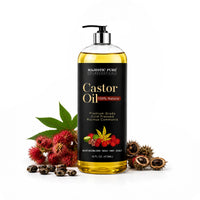
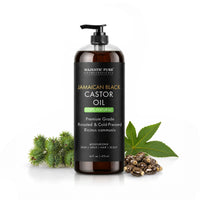
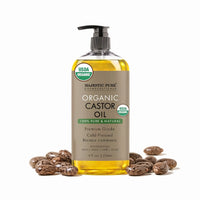
Castor oil is typically cold-pressed, meaning the seeds are mechanically crushed without added heat or chemical solvents. Cold-pressing preserves the oil's natural fatty-acid profile and is the standard for USDA Organic-certified castor oil, such as Majestic Pure USDA Organic Castor Oil. Some industrial-grade castor oil is produced using heat or solvent extraction, but this is generally reserved for non-cosmetic, technical applications like lubricants and industrial coatings.
What Are the Key Constituents of Castor Oil?
Castor oil is unusual among plant oils because roughly 85–90% of its fatty acid content is ricinoleic acid, a monounsaturated omega-9 fatty acid rarely found in other vegetable oils at this concentration. This gives castor oil its signature thick, viscous texture and long-lasting occlusive (moisture-sealing) feel on skin and hair.
|
Constituent |
Approximate % |
Function |
|
Ricinoleic acid |
85–90% |
Occlusive, emollient |
|
Oleic acid |
3–6% |
Skin conditioning |
|
Linoleic acid |
3–5% |
Barrier support |
|
Stearic/Palmitic acid |
1–2% |
Texture stabilizer |
What Is Castor Oil Used For?
-
Hair and scalp oiling: massage into the scalp to deeply moisturize
-
Lash and brow routines: apply nightly with a clean applicator for best results
-
Dry skin repair: used on rough patches, heels, elbows, and cuticles
-
Belly and lymphatic massage: a traditional practice for lymphatic drainage
-
Nail and beard care: work into nails or beard hair for conditioning
Is Castor Oil Safe to Use?
Castor oil is generally recognized as safe for topical use and is FDA-registered for cosmetic applications. It's non-comedogenic for most skin types in small amounts but can feel heavy if overapplied as a few drops go a long way. Castor oil is not intended for internal/oral use as a home remedy without medical guidance. Additionally, pregnant individuals should consult a doctor before any castor oil pack or massage practice.
What Is Frankincense Oil?
Frankincense essential oil is steam-distilled from the resin (not the wood or leaves) of Boswellia trees, most commonly Boswellia carterii, Boswellia sacra, or Boswellia serrata.
Where Does Frankincense Come From?
Boswellia trees grow in arid, rocky terrain across Somalia, Oman, Yemen, and parts of India. Small cuts are made in the bark, and the tree exudes a milky resin (called "tears") that hardens on contact with air. This resin has been traded for over 5,000 years, historically along incense routes connecting Arabia to the Mediterranean.
How Is Frankincense Extracted?
The hardened resin tears are collected, sorted by grade, and then steam-distilled. Steam is passed through the resin, vaporizing the volatile aromatic compounds, which are then condensed back into liquid essential oil. This process requires a substantial volume of raw resin to yield a comparatively small amount of oil, which contributes to frankincense's higher price point relative to leaf- or petal-derived oils.
What Are the Key Constituents of Frankincense Oil?
|
Constituent |
Typical Range |
Function |
|
Alpha-pinene |
20–35% |
Aromatic, "green" top note |
|
Limonene |
10–20% |
Uplifting citrus-like note |
|
Boswellic acids (trace in EO) |
Trace |
Associated with the plant's traditional reputation |
|
Sabinene/Myrcene |
Varies |
Woody-balsamic depth |
What Is Frankincense Oil Used For?
-
Aromatherapy diffusion grounding, meditative scent often used during wind-down routines
-
Facial oil blends diluted into a carrier oil for mature or uneven-toned skin routines
-
Massage blends combined with a carrier oil for a calming full-body massage
-
Scar- and texture-focused skincare rituals used traditionally, though results are anecdotal rather than clinically standardized
Is Frankincense Oil Safe to Use?
Frankincense essential oil must always be diluted in a carrier oil before skin contact. Never apply undiluted essential oil directly to skin. A standard dilution for facial use is 0.5–1% (roughly 1 drop per teaspoon of carrier oil), and 2–3% for body massage. Those who are pregnant, nursing, or on blood-thinning medication should consult a physician first.
What Is Lavender Oil?
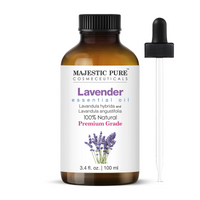
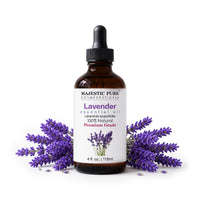
Lavender essential oil is steam-distilled from the flowering tops of Lavandula angustifolia (true lavender), the species most associated with the calming, floral-herbaceous scent used in wellness routines.
Where Does Lavender Come From?
True lavender grows best in well-drained, sunny, high-altitude conditions. France's Provence region is historically the most famous source, though Bulgaria has become one of the largest global producers of lavender oil in recent years.
How Is Lavender Oil Extracted?
Lavender flowers are harvested at peak bloom and steam-distilled, usually within hours of cutting to preserve the delicate aromatic compounds.
What Are the Key Constituents of Lavender Oil?
|
Constituent |
Typical Range |
Function |
|
Linalool |
25–38% |
Calming floral note, gives lavender's signature scent |
|
Linalyl acetate |
25–45% |
Sweet, soft floral-fruity note |
|
Terpinen-4-ol |
2–6% |
Herbaceous depth |
|
Camphor |
Under 1% (true lavender) |
Higher levels signal Lavandin, a sharper-scented hybrid |
What Is Lavender Oil Used For?
-
Bedtime diffuser routines added to water in an ultrasonic diffuser
-
Pillow and linen sprays diluted and misted for a calming environment
-
Diluted skin application added to a carrier oil for temple or neck massage
-
Bath rituals a few drops mixed with a carrier oil before adding to bathwater
Is Lavender Oil Safe to Use?
Lavender is considered one of the gentler essential oils but still requires dilution before skin contact with a common guideline of 1–2% for adult body use. It should be kept away from young children's skin without professional guidance, and undiluted oil should never contact the eyes or mucous membranes.
Castor vs. Frankincense vs. Lavender: Quick Comparison
|
Castor Oil |
Frankincense Oil |
Lavender Oil |
|
|
Type |
Carrier (fatty) oil |
Essential oil |
Essential oil |
|
Source part |
Seed |
Resin |
Flower |
|
Extraction |
Cold-pressed |
Steam-distilled |
Steam-distilled |
|
Apply undiluted? |
Yes, in small amounts |
No. Always dilute |
No. Always dilute |
|
Primary use case |
Hair, lash, dry-skin nourishment |
Grounding aromatherapy, facial oil blends |
Calming aromatherapy, sleep routines |
|
Featured product |
Majestic Pure USDA Organic Castor Oil |
Majestic Pure Frankincense Essential Oil |
Majestic Pure Lavender Essential Oil |
Frequently Asked Questions
Can I mix Castor, Frankincense, and Lavender together?
Yes. A common combination uses Majestic Pure USDA Organic Castor Oil as the carrier base, with a few drops each of Frankincense and Lavender essential oils blended in for a calming, skin-nourishing massage oil.
Which of these oils is best for sleep?
Lavender is the most widely used of the three for bedtime and sleep-focused aromatherapy routines.
Is Frankincense the same as Frankincense resin or incense?
No. Raw frankincense resin is the hardened tree sap traditionally burned as incense. Frankincense essential oil is the steam-distilled liquid extracted from that same resin.
Do I need to dilute Castor Oil like I do Frankincense and Lavender?
Not in the same way. Castor is a carrier oil and is generally safe to apply directly in small amounts. Frankincense and Lavender must always be diluted in a carrier oil before touching skin.
How long do these oils last once opened?
Carrier oils like castor oil typically last 1–2 years once opened. Essential oils like Frankincense and Lavender can last 2–4+ years when stored in a cool, dark place with the cap tightly sealed.
Are these oils regulated for purity?
Reputable brands test for purity and label oils with their botanical (Latin) name and extraction method. Majestic Pure products are FDA registered, and the castor oil line carries USDA Organic certification.